


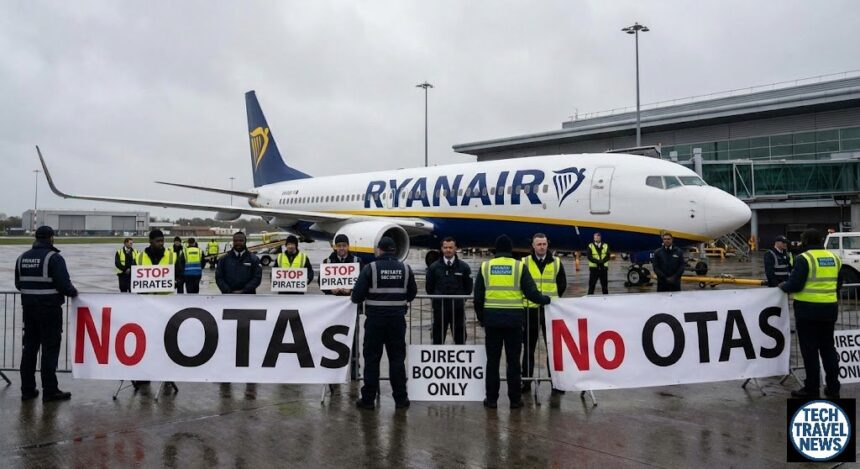
Ryanair has officially ended one of its most high-profile corporate feuds, signing a landmark partnership agreement with Booking Holdings that halts years of legal battles and “pirate” rhetoric. However, while peace has been declared with the owner of Booking.com, the Irish airline continues to wage war against other online travel agents (OTAs) it accuses of overcharging customers.
The Historic Truce
In a significant U-turn from early 2024—when Ryanair branded Booking.com and its sister sites as “pirates”—the airline announced a comprehensive partnership in August 2025. The deal covers Booking Holdings’ major travel brands, including Booking.com, KAYAK, Priceline, and Agoda.
Under the new terms, these platforms are now authorized to sell Ryanair flights with full price transparency, meaning consumers will see the exact same fares on Booking.com as they would on Ryanair’s own website. Crucially, the deal removes a major friction point for passengers: customers booking through these platforms will now have direct access to their myRyanair accounts without needing to undergo the airline’s arduous customer verification process (facial recognition), ensuring they receive essential flight updates directly.
“This partnership shows how ‘Approved OTAs’ and Ryanair can work together to protect and benefit consumers, giving them more choice at lower fares,” said Ryanair CMO Dara Brady.
Todd Henrich, SVP of Corporate Development at Booking Holdings, added that the deal combines Ryanair’s low fares with the “ease and flexibility offered by our brands,” building a “seamless booking experience.”
From Courtroom to Boardroom
The partnership follows a decisive legal victory for Ryanair in the United States. In July 2024, a federal jury in Delaware ruled that Booking.com had violated the Computer Fraud and Abuse Act (CFAA) by accessing the protected “myRyanair” section of the airline’s website without authorization—a practice Ryanair calls “screen scraping.”
While the jury awarded only nominal damages of $5,000, the verdict established a critical legal precedent that strengthened Ryanair’s hand in negotiations. It validated the airline’s long-standing argument that unauthorized intermediaries were scraping data in a way that violated terms of use.

The “Approved OTA” Strategy Expands
The Booking Holdings deal is part of a broader shift in Ryanair’s distribution strategy throughout 2025. The airline has moved from a blanket ban on intermediaries to a “verify and partner” model. Booking Holdings joins a rapidly growing list of “Approved OTAs” that have agreed to Ryanair’s terms, including:
- Expedia Group
- TUI
- On the Beach
- Kiwi.com
- loveholidays
- El Corte Inglés
Furthermore, Ryanair has introduced a new tier of partnership for B2B technology providers, designating companies like Paxport, Travelfusion, and DerbySoft as “Approved OTA Aggregators.” These deals allow tech platforms to distribute Ryanair fares to their own networks of travel agents, provided those agents maintain price transparency.
New Information: The War is Not Over
Despite the peace treaty with Booking Holdings, Ryanair has not softened its stance on intermediaries it still considers “rogue.” As of December 2025, the airline remains locked in a bitter dispute with eDreams ODIGEO and other smaller OTAs like Vola and Fru.
In its November and December 2025 OTA Surveys, Ryanair accused these remaining unapproved agents of overcharging consumers by as much as 240% (up to 3 times the ticket price) and adding hidden markups to ancillary services like baggage and seat selection.



The conflict with eDreams has been particularly litigious. In July 2025, a Commercial Court in Barcelona ruled against Ryanair, finding the airline guilty of “denigration” and “unfair competition” regarding its public statements about eDreams’ Prime subscription service. Ryanair immediately vowed to appeal the ruling, calling it “bizarre” and maintaining that it would continue to expose what it terms “consumer harm.”
Financial Impact
The shift to authorized partnerships appears to be stabilizing Ryanair’s passenger load factors, which faced a brief wobble in early 2024 when major OTAs suddenly removed the airline’s flights. By late 2025, ancillary revenue—which includes the bags and seat fees often marked up by unauthorized agents—remained a cornerstone of the business, accounting for approximately 30-32% of total income.
By bringing giants like Booking.com into the fold, Ryanair secures its distribution reach while maintaining control over the customer relationship—a critical victory in its quest to carry 300 million passengers by 2034.