


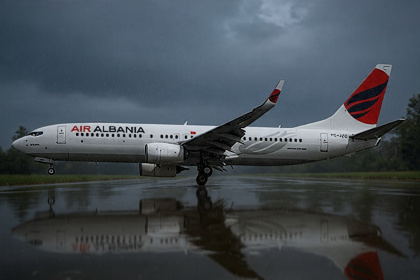
The ambitious project of giving Albania a national airline has ended in turbulence, silence, and ultimately, a complete shutdown. Just weeks after local media outlet CNA published a scathing investigation alleging systematic mismanagement and embezzlement, Air Albania has ceased operations, leaving passengers stranded and creditors unpaid.
What was once heralded as a symbol of national pride is now the subject of a financial post-mortem, revealing a pattern of corporate neglect, alleged theft, and a strategic withdrawal by its primary backer, Turkish Airlines.
A Death Foretold
The crisis reached its peak in mid-December 2025, when the Albanian Civil Aviation Authority officially revoked Air Albania’s operating license. The decision followed the airline’s abrupt suspension of all flights around December 7, a move that confirmed long-standing rumors of insolvency.
However, according to investigative reporting by CNA, the collapse was neither sudden nor accidental. Throughout 2025, the outlet exposed a series of irregularities suggesting that the airline was being “hollowed out” from the inside.
“The investigation began by looking for balance sheets at the Central Bank, which simply did not exist,” the CNA report stated. When journalists pressed for answers regarding the missing financial data, both the airline’s management and its auditor, Ernst & Young (EY), reportedly maintained absolute silence.
The “Ghost” Passengers and Financial Black Holes
One of the most damaging revelations concerns alleged billing fraud. Court documents cited by local investigators uncovered a discrepancy in catering costs, showing that the airline was billed for 120 business class meals daily—effectively an entire plane’s worth of premium passengers every single day—despite load factors that did not support such figures.
This “overbilling scandal,” as described by local media, is now suspected to be part of a mechanism to siphon millions of euros out of the company.

Simultaneously, the airline’s operational debts were mounting. Reports confirm that Air Albania defaulted on aircraft lease payments, leading to legal action from lessors, including Ukrainian carrier SkyUp, which had provided aircraft on an ACMI (Aircraft, Crew, Maintenance, and Insurance) basis. When questioned about unpaid leases, foreign partners offered a telling “no comment.”
The Turkish Airlines Exit: A Strategic Pivot?
Crucial to the airline’s demise was the role of Turkish Airlines, which held a controlling 49% stake. While the parent company had initially promised a fleet of seven aircraft, Air Albania struggled to maintain even two operational jets.
The final blow came in November 2025, just weeks before the total collapse, when Turkish Airlines announced the sale of its entire stake in the Albanian carrier. Analysts point to a shift in strategy in Istanbul; having secured a massive investment deal with the Spanish carrier Air Europa, Turkish Airlines appears to have cut its losses in the Balkans to focus on the lucrative Western European market.
Without the financial lifeline and operational expertise of its parent company, Air Albania was left defenseless against its accumulating debts.


The Aftermath
As of January 2026, the fallout continues. Former employees are reporting months of unpaid wages, and the state is left dealing with the reputational damage of a failed flag carrier.
What remains is a cautionary tale of corporate opacity. As CNA concluded in their report, the trajectory of Air Albania bears the hallmarks of a “directed and well-orchestrated attack,” designed not to build an airline, but to extract capital until the inevitable crash.
With the license revoked and the fleet grounded, the focus now shifts to the prosecutors, as the public awaits answers on where the millions intended for Albania’s wings actually went.