





The window for preparation is closing. Hotels that utilize 2026 to embrace AI transformation will likely see higher profitability, better operational efficiency, and deeper guest loyalty. Those that ignore the shift face a future where they can no longer compete with the speed and personalization that travelers will come to expect.
The hotel industry is standing at a technological precipice. According to the latest 2026 Hospitality Industry Outlook released by hospitality tech leader Mews, 2026 will not just be another year of gradual change—it will be the definitive turning point for Artificial Intelligence (AI) adoption in the sector. The report warns that hoteliers who fail to lay the groundwork now risk obsolescence as AI becomes the standard for both operational efficiency and guest expectations.
The Vision: From 2026 to 2035
While 2035 is projected to be the era where AI autonomously manages the vast majority of the guest journey—from discovery to checkout—2026 is identified as the critical “preparation phase.” This is the year hotels must overhaul their data, systems, and teams to accommodate the shift.
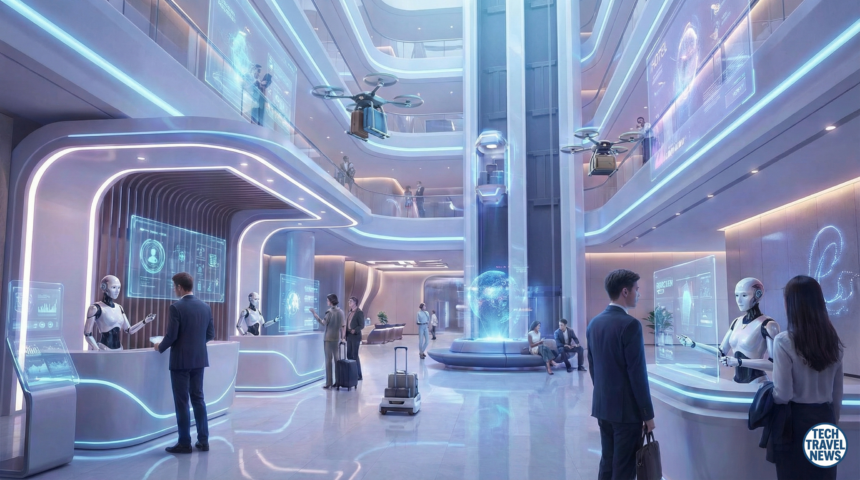
The future guest experience will be characterized by speed and hyper-personalization. “Conversational AI” will allow travelers to find and book rooms in a single interaction, reducing the need for traditional browsing. Consequently, hotel visibility will depend less on advertising budgets and more on having structured, AI-readable content and open APIs.
5 Key Shifts Redefining the Industry
Mews identifies five major transformations that will dominate the landscape:
- Conversational Booking: Search and booking will merge into a fluid conversation driven by generative AI. Hotels must ensure their digital content is clean and structured to be “read” effectively by these algorithms.
- Agentic AI in the Back Office: AI will move beyond chatbots to handle complex backend operations, including inventory management, housekeeping schedules, and internal communications.
- Direct Guest Relationships: AI offers hotels a chance to break free from the dominance of Online Travel Agencies (OTAs). By utilizing AI to offer superior, personalized direct booking experiences, properties can reclaim guest loyalty.
- The Evolution of Staff: As algorithms take over transactional duties (check-ins, data entry), human staff will pivot to roles centered on empathy, creativity, and emotional intelligence—delivering the “high-touch” moments AI cannot replicate.
- 2026 as the Inflection Point: This is the year to pilot systems and clean up data. Waiting until the late 2020s to adopt these technologies will likely be too late to catch up.
The AI Readiness Checklist
To help hoteliers navigate this transition without overwhelming their operations, Mews suggests a four-step approach:

Audit Your Tech Stack: Map out all current systems (PMS, CRM, Payments) to identify data silos. Ensure your vendors are building open APIs and AI-capable features.
Structure Your Content: AI needs a “single source of truth.” Ensure all property information, from room dimensions to FAQs, is consistent and digital-ready across all channels.



Start Small: Do not attempt a full-scale overhaul overnight. Pilot a specific, low-risk use case—such as automating routine email responses or summarizing guest feedback—to measure success before scaling.
Governance & Training: Form cross-functional teams to oversee AI integration. Staff must be trained not just on how to use new tools, but on how their roles will shift toward more guest-centric activities.